The broad label of BorActin Insecticide Powder, a long-lasting non-repellent dust, allows for a wide choice of application methods such as a liquid spray, foam or even a mop solution or drain treatment. The product combats crawling insects such as cockroaches, ants and silverfish, as well as small flies (drain flies, fruit flies and phorid flies). It can be used in residential, commercial, industrial and agricultural applications, including both food and non-food areas, and for darkling beetle control in poultry houses.
Precision milling in pharmaceutical-grade equipment yields a superfine, odorless powder with no clumping and superior “dustability.” It is excellent for void treatments.
BorActin contains 99 percent boric acid as the active ingredient and is not corrosive to stainless steel. It remains active until removed and will not break down in heat or ultraviolet (UV) light. It is available in a one-pound bottle, a five- and 25-pound pail, and in a box of 36 four-ounce mop packets.
About Rockwell Labs
Founded in 1998 by Pest Management Professional Hall of Famer Dr. Cisse Spragins (Class of 2018), North Kansas City, Mo.-based Rockwell Labs offers products that are conceptualized, developed and formulated in-house. New products undergo extensive testing in-house, in the field and at major universities before they are produced and launched in the professional market.
A business valuation helps owners understand what their company is truly worth, whether for a sale, succession planning, financing, or long-term growth strategy. It can also identify opportunities to increase value and improve future marketability.
Cetane provides detailed, market-based valuations backed by real transaction data and extensive mergers and acquisitions (M&A) experience in the residential and commercial service industries, giving business owners accurate insights they can trust.
About Cetane Associates
Cetane is a leading provider of financial advisory services to business owners in the propane, heating oil, pest control, lawn care, landscaping, HVAC and plumbing industries. Clients engage Cetane to advise on sales, spin-offs and acquisitions, as well as to perform valuation and ad hoc corporate finance assignments.
Select Exterminating, based in Franklin Square, N.Y., has purchased two New York firms — Hamburg-based Suburban Pest Control and Dunkirk-based Amherst Exterminators — as well as On The Spot Pest Control, based in Metuchen, N.J. All three acquired companies are clients of Pest Management Professional’s father-and-son columnists Stuart and Daniel Aust and their team at The Aust Group. The terms of the transactions were not disclosed.
Founded in 1983, Suburban Pest Control has provided residential and commercial pest management services throughout Western New York for more than four decades. Under the leadership of second-generation owners Marty and Mary Ballowe, the company is the official pest control provider for several professional sports organizations, including the Buffalo Bills and Buffalo Sabres.
Amherst Exterminators traces its roots to 1994, when Ken Drummond and Rick Crandall founded Comfort Pest Control. Following the partnership with Amherst Exterminators in 2006, the company continued to expand through strategic growth before officially rebranding as Amherst Exterminators in 2020.
Established in 2010, On The Spot Pest Control serves customers throughout Somerset, Union, Middlesex, and Morris counties. Owners Chris and Andrea Piazza built the business by delivering responsive, environmentally conscious pest control solutions backed by customer service. The company is an active member of both the National Pest Management Association (NPMA) and the New Jersey Pest Management Association (NJPMA).
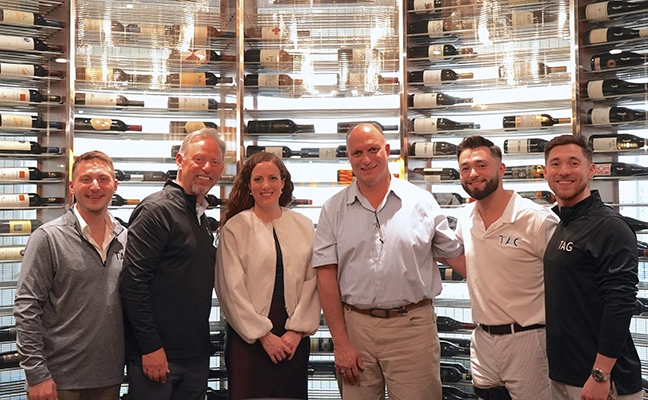
Pictured from left are Dan Aust, Stuart Aust, Hope Scott, Marty Ballowe, Nick Aust and Chris Aust. IMAGE: THE AUST GROUP
About Select Exterminating
Select Exterminating was originally founded in 1959 and purchased in 1990 by Lloyd Garten. Today, the business is run by his son, Matthew Garten, who oversees the firm’s strategic partnerships.
About TAG
The Aust Group (TAG), established by former pest management professional Stuart Aust, is a family-based mergers and acquisitions (M&A) firm that specializes in advising owners and shareholders through the M&A process. TAG combines transactional expertise and pest control experience to deliver maximum value to clients. Its primary focus is exclusively on the pest control industry, and the team works alongside high-growth companies operating on a recurring business model. Additionally, TAG provides comprehensive valuation services to determine a range of values for businesses and offer strategic recommendations to optimize enterprise value before engaging in a competitive M&A process.
Susan Masciarelli, president, CEO and owner of Web-Cote Industries, has been selected as one of the inaugural 50 Women to KNOW in New Jersey and is featured in the program’s hardcover publication. Masciarelli and her fellow honorees were celebrated at the Women to KNOW in New Jersey Gala on Oct. 6.
Per a news release, the program was presented by The KNOW Women, “a media company, print and digital publisher, and private networking community dedicated to elevating and connecting accomplished women. The Women to KNOW recognition celebrates professional achievement, leadership and community impact. Its New Jersey hardcover publication shares the stories of the selected honorees and recognizes their contributions. Honorees are selected through a nomination, review and interview process by a panel of previous honorees and community members. Selection considers professional accomplishments, industry leadership, community or philanthropic impact, and a commitment to supporting and empowering women, including through mentorship and advocacy.”
Masciarelli joined Hamburg, N.J.-based Web-Cote Industries in 2008 and advanced through operations and executive leadership roles. She purchased the company in 2024.
“Purchasing Web-Cote was the realization of a goal I had worked toward for years,” Masciarelli said in the news release. “Ownership has brought new challenges, responsibilities and opportunities to grow. Being included among these accomplished women gave me a moment to appreciate that journey and the people who have helped make it possible.”
In addition, through her work in helping to develop the Responsible Glue Trap User (RGTU) training program, Masciarelli advocates for “responsible, informed use of glue traps, emphasizing education, sound judgment and accountability in pest management.”
“Working in the traditionally male-dominated manufacturing and pest management industries has shown me how much it matters for women to see a path to leadership and ownership,” Masciarelli said in the news release. “I’m grateful for the people who encouraged me along the way, and I want to help other women see what is possible for themselves.”
About Web-Cote Industries
Web-Cote Industries is a woman-owned manufacturer based in Hamburg, N.J., producing glue-based pest management products for the professional pest control industry. The company serves pest management professionals (PMPs) through original equipment manufacturing (OEM), private label capabilities and the trademarked Pro-Trap branded glue-based pest management products. Web-Cote Industries is a Women’s Business Enterprise National Council (WBENC)-certified Women’s Business Enterprise.
For pest management professionals (PMPs), effective rodent control depends on reliable tools that perform consistently in the field. Kness Snap-E Mousetraps and Big Snap-E Rat Traps are engineered for precision, power and durability, giving PMPs the confidence to tackle rodent challenges across a variety of service environments. When every service call is an opportunity to deliver results and earn customer trust, having dependable equipment makes a difference.
Give your customers the results they expect and your business The Pro’s Edge.
About Kness Pest Defense
Per company history, the Ketch-All was invented by a young, widowed father of six, Austin Enos “Brick” Kness, in 1924. Mice were prevalent at the high school in which Kness was a custodian, “and led him to the idea of the ‘box’ trap. He built the first trap from a square oilcan, a Tuxedo Tobacco can, a spring from a curtain rod, and the wood base of a crate. The first night he set his trap, he captured five mice.
“He was elated and showed the teachers and his friends. He was encouraged to build others for his friends and to seek a patent. By 1927, Kness Mfg. Co. was formed to produce the KetchAll Automatic Mousetrap and another of Kness’ inventions, the RotoBow tree saw.”
Newly introduced by Ensystex, the PETI Mouse Station delivers maximum placement versatility in a compact footprint. Designed with an ultra-low clearance profile of just 1.5 inches (5 × 4 × 1.5 inches), it fits seamlessly into tight, restricted spaces where traditional stations cannot go. The PETI station features integrated screw knockouts for secure mounting and a single-key operation for fast, efficient servicing. Cost-effective and built for fast deployment, it is packaged in cases of 72 stations.
About Ensystex
Ensystex was founded in 1994 by pest control operators intent on changing the landscape of the professional pest control industry. Ensystex has the expertise to synthesize, source, formulate, manufacture, promote and distribute a wide range of products to pest management professionals. With products for termite and general pest control — as well as turf and ornamental — the company sells to thousands of pest and turf and ornamental management professionals around the world. Products include:
Pest management professionals (PMPs) and more importantly, their clients, are well aware of diseases transmitted by ticks and mosquitoes because illnesses such as West Nile virus has made headlines lately. Just this week, two people in North Carolina died due to West Nile virus, according to the state’s Department of Health and Human Services, according to The News & Observer.
The data confirm this trend, as a Centers for Disease Control and Prevention (CDC)report tracked the most reported causes of these arboviral diseases, and West Nile virus tops its most recent list.
West Nile virus was the most reported cause of arboviral disease in the United States in 2024, the report showed. In 48 states and the District of Columbia, 1,955 arboviral disease cases were reported in 2024, including 189 deaths. West Nile virus accounted for 1,808 of those cases, or 92 percent of the reported arboviral disease cases. Of those, 173 patients died. Reported West Nile virus cases in 2024 dropped below the 10-year median of 2,162 cases, however.
The second most reported arboviral disease in 2024 was Powassan virus. The 60 cases that year surpassed the previous high of 49 cases in 2023. All 60 patients were hospitalized and nine died. Over the past 21 years, the number of Powassan virus cases increased by an average of 17.5 percent annually, according to the CDC report.
Notably, the Kay Hagan Tick Reauthorization Act was signed into law Sept. 30 of this year to extend federal initiatives to combat tick-borne diseases first established through the Kay Hagan Tick Act. The law is named for former Sen. Kay Hagan, D-N.C., who died in October 2019 from complications of Powassan virus.
“The 2024 data show arboviruses continue to be a significant threat to people’s health in the U.S.,” a CDC spokesperson told Infectious Disease Special Edition. “With no medicines or vaccines available to treat or prevent arboviruses endemic in the U.S., it is especially important for people at higher risk to take steps to prevent mosquito and tick bites, particularly as there has been an early and strong start to the arboviral season in 2026.”
The CDC offers tipson how to prevent tick and mosquito bites. It acknowledges exposure to ticks may occur year-round, and mosquitoes may be active day and night. PMPs can share the CDC’s tips with clients to help them reduce exposure that may make them sick.
Founded in 2015 by “TheBugBrothers” Blair, Clint, Lars, Cody and Gordon Martinson, GreenForce’s mission statement is We cultivate a strong family through integrity and hard work to create Pest Free Living.
“Houston is an important market for AXN, and we’re excited to enter it alongside a company like GreenForce,” Brent Agee, CEO of AXN Growth Partners, said in a news release. “Blair, Clint, Lars, Cody and Gordon have done an incredible job building GreenForce, and I want to thank the Martinson brothers for trusting AXN with the next chapter of the business. Blair will continue leading GreenForce as brand president, and our role is to support him and his team with the resources, infrastructure, and experience needed to take GreenForce to the next level.”
“We had the opportunity to consider multiple potential partners, so it was important for us to find the right fit for our team and the future of GreenForce,” Blair Martinson, co-founder and brand president of GreenForce Pest Solutions, said in the news release. “AXN stood out because they understand the pest control industry, value what we’ve built, and share our ambition for where we can take the business. Knowing I could continue leading GreenForce while gaining the resources and support to accelerate our growth made AXN the right partner for us.”
About GreenForce Pest Solutions
Founded by the Martinson brothers, GreenForce Pest Solutions is a Spring, Texas-based pest control company serving customers throughout the greater Houston area. With its Bug Tested, Mother Approved approach, GreenForce says it has built its business around “dependable service, strong customer relationships and a commitment to protecting the homes and families it serves.”
About AXN Growth Partners
AXN Growth Partners is a platform for pest professionals, built by pest professionals. The company partners with founders who join a network of experienced operators to scale their businesses while retaining ownership and participating in future value creation. Since 1969, AXN has delivered best-in-class pest and termite services through a high-touch, customer-first approach. Today, AXN brands are among the fastest-growing in the nation, earning recognition on the Inc. 5000 as well as Best Places to Work lists. AXN continues to expand its footprint and service offerings to meet the evolving needs of residential and commercial customers.
The OvoControl Urban Feeder is a state-of-the-art pigeon control solution designed for effective and precise bait distribution in public spaces. It is designed for permanent installation in public spaces such as parks, plazas, parking lots and other hard or paved surfaces where pigeons tend to gather. Resembling a trash receptacle, it seamlessly blends into its surroundings, ensuring minimal visual disruption. The protective cage at the base secures its advanced feeding mechanism, resulting in a robust and reliable solution for dispensing OvoControl.
About Innolytics
Innolytics is based in La Qunita, Calif. It is a privately held company developing contraceptive technology for wildlife. Innolytics’ product, OvoControl (brand of nicarbazin) represents contraceptive control for birds. OvoControl is available directly to pest management professionals through Innolytics or industry distributors.
Atlanta, Ga.-based Arrow Exterminators held its annual Fiscal Year Leadership Summit July 29 and 30 to celebrate a record-breaking 2025-2026 fiscal year.
More than 500 team members and partners descended on the Omni Hotel in Atlanta, where Arrow Exterminators recognized outstanding achievements from across the company, including surpassing $475 million in total revenue.
The event also set the stage for continued growth in 2026-2027, as the company introduced its new internal fiscal year theme, “Lead Every Day: Chasing Greatness.”
Arrow Exterminators was founded in 1964 and is the largest family-owned pest and termite control company in the United States, ranked by revenue. Chairman of the Board Joe Thomas is a Pest Management Professional Hall of Famer (Class of 2009).
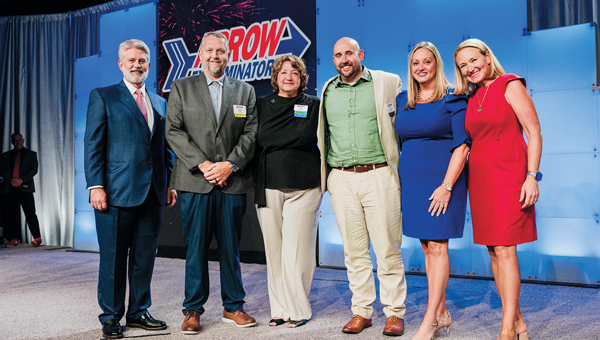
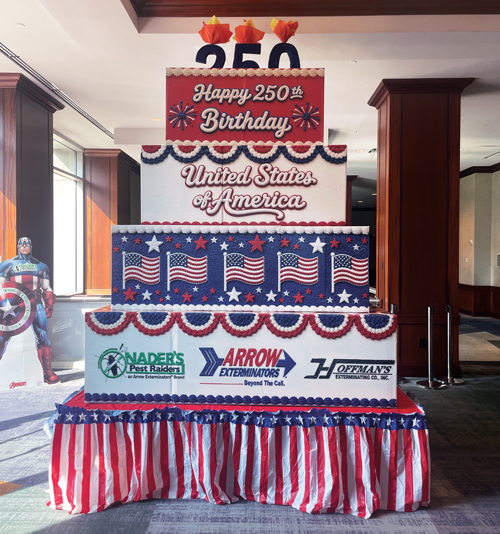
Words to live by: Arrow Exterminators President and COO Tim Pollard said the “Lead Every Day: Chasing Greatness” theme refers to “the choices we make every day, how we support our teams, and how we continue raising the bar for ourselves and our company.” (PHOTO: KELLI PRICE PHOTOGRAPHY)The dream team: The Fiscal Year Leadership Summit brought together company executives, managers and corporate support teams to recognize outstanding achievements. Pictured from left are President and COO Tim Pollard, Service Center Manager Chris Sprinkle, VP of Benefits Hali Smith, Service Center Manager Joe Conway, Chief Administrative Officer Shay Runion and CEO Emily Thomas Kendrick. (PHOTO: KELLI PRICE PHOTOGRAPHY)A joint celebration: The Fiscal Year Leadership Summit marked the nation’s 250th birthday with festive décor such as this creative “cake,” which looked good enough to eat. (PHOTO: PMP STAFF)Class(y) reunion: More than 500 Arrow Exterminators team members and partners attended the two-day event. Presentations held during lunch and dinner gave attendees the opportunity to catch up with old friends and treasured colleagues. (PHOTO: PMP STAFF)
The Maryland State Pest Control Association (MSPCA), the Virginia Pest Management Association (VPMA) and other partnering organizations will offer a 100 percent virtual, live-streaming Spanish-Language Pest Control Training Course, designed to provide professional pest management education entirely in Spanish, on Thursday, Oct. 15, 2026, from 9 a.m. to 3:30 p.m. Eastern.
The course is intended for Spanish-speaking applicators who are preparing to become Registered Technicians, as well as currently certified technicians seeking recertification credits in Maryland, Pennsylvania, Virginia and West Virginia, but is open to anyone who is looking for solid pest control training.
By offering the training entirely in Spanish and in a fully virtual format, the organizing sponsors hope to make professional education more accessible, support workforce development, and help Spanish-speaking pest management professionals strengthen their technical knowledge and meet certification requirements without the need to travel.
Recertification credits have been approved in Maryland for Categories 3A, 3C, 6, 7A, 10, and CORE. Credits have also been applied for in:
Pennsylvania: Categories 06, 07, 10, 11, and 18
Virginia: Categories 3A, 3B, 6, 7A, and 10
West Virginia: Categories 4A, 7, 8A, and 11
The cost to attend is $50 per person. Because this is a live virtual training, each participant must register with an individual email address in order to receive a personalized Zoom access link and meet attendance requirements for certification or recertification credit.
Pest management companies are encouraged to share this opportunity with Spanish-speaking employees who may benefit from certification preparation or continuing education. For additional information or to register, visithttps://tinyurl.com/spanish-pesticide-training.
About MSPCA & VPMA
The Maryland State Pest Control Association and the Virginia Pest Management Association represent and supports pest management professionals through education, training, industry resources, and professional development opportunities. This event is co-sponsored by the Maryland Department of Agriculture, the Virginia Department of Agriculture, the University of Maryland, Virginia Tech and West Virginia University.
Fall is prime time for yard cleanup, and many of your clients will soon be firing up their leaf blowers to clear their lawns of falling leaves and branches before winter sets in.
A common recommendation is to keep a well-maintained property to comabat a wide range of pest problems. But advising your clients on exactly how they manage the accumulation of landscape debris, especially leaf litter, can be just as important in reducing tick pressure as we approach the colder months.
A 2020 study published in the Journal of Medical Entomology looked at the impacts of blowing leaves into the wooded edge of a property rather than bagging or composting them. Researchers found that properties with accumulated leaf piles had up to three times more host-seeking nymphs of the blacklegged tick (Ixodes scapularis) than in untouched natural edges or the surrounding forest, compared to those properties where leaves were removed.
Thick leaf litter traps moisture and moderates temperature, creating a perfect refuge for the nymphs. By concentrating leaves along the transitional edge where lawns met woods, homeowners unintentionally created a prime tick habitat where their family and pets are most likely to pass through on a daily basis. Plus, when you consider that rats and mice also use brush piles to overwinter, you now have a perfect storm of rodent harborage and tick habitat that could encourage disease transmission.
This fall, encourage your clients to rethink where their yard debris ends up. Recommend bagging leaves for curbside pickup or composting rather than blowing or raking them toward the woods. If a landscaping contractor handles the property, ask that collected leaves be hauled offsite, or at least moved well away from high-traffic lawn edges instead of piled at the property line.
Mowing and trimming vegetation along that same transition zone adds another layer of protection, keeping the border drier, sunnier and far less hospitable to questing ticks.
The residential version of this story is simple: A garage door seals against a slab with a rubber gasket; the gasket wears; the mouse comes back. One opening, one wear item.
A loading dock is not one opening. It is four systems stacked on top of one another, built by different trades, maintained by nobody in particular, and the account manager calls the whole assembly “the dock door.” That is why the shipping area is the part of a manufacturing account that never stays clean.
The header above an overhead door is quiet, dry and almost never disturbed, which is why it collects webs and nests long before anyone notices. IMAGE: SEASIDE GARAGE DOOR EXPERTS
1. The pit, not the door
Start with the thing that stays open whether the door is up or down.
Most docks use a pit-style leveler, which is a steel deck that sits in a formed concrete pit, hinged at the back, with a lip that folds out onto the trailer. The leveler has to move inside that pit, so it cannot be tight against it. The standard result is a gap of roughly 1 inch running down both sides of the leveler and across the rear of the pit, open to outside air at the dock face.
That gap does not care about the overhead door. It is below it and behind it. A facility can shut every door at 6 p.m. and still have three open slots per dock position, plus the chain pull slot, plus the plug holes left from installation, plus whatever gap has opened between the transition plate and the concrete.
A quarter inch is a mouse. Half an inch is a rat. One inch by 3 feet, times four dock positions, is a highway.
Check it with the door down and the leveler stored, from outside, in daylight. You are looking straight into the building. If you can see the inside of the warehouse from the driveway with everything closed, that is your finding, and it outranks anything you will write about the door itself.
2. The corners of the dock seal
The foam pads around the opening are there so a backed-in trailer closes the gap between the truck and the building. They wear in a predictable pattern. The head pad at the top takes the beating; the side pads pull loose at the top corners. And what opens up is a small triangle at each upper corner where the head pad and the side pad no longer meet.
Look at the two top corners, not the middle. That is the same rule as the residential door, for the same reason: Everybody looks at eye level.
If the account runs dock shelters instead of seals, the wear shows in the curtain edges where the trailer body rubs, and in the bottom 6 inches where the tires and the bumpers hit.
3. A rolling steel door is not a weather door
This one surprises people, and it is worth knowing because it changes what you write in your inspection report.
A rolling steel service door is a curtain of interlocking slats riding in two guides, coiled on a barrel above the opening, covered by a sheet metal hood. None of that is a seal. The guide seals, the hood baffle and the rubber astragal on the bottom bar are separate line items that somebody either specified when they bought the door or did not.
On a 15-year-old warehouse door, for example, usually they did not. Even if they had, by now the seals have likely become brittle or were torn off by a forklift, and never came back. So look at three places on a rolling door: down both guides where the curtain meets the track, along the bottom bar, and up at the hood.
The hood is the one that gets missed. It is a cover over the coil, not a closed box, and on a lot of buildings it is the warmest, driest, most undisturbed spot on the exterior wall. Birds find it first. Then it is a nesting site 12 feet up with a direct line into the building.
4. The door that is never closed
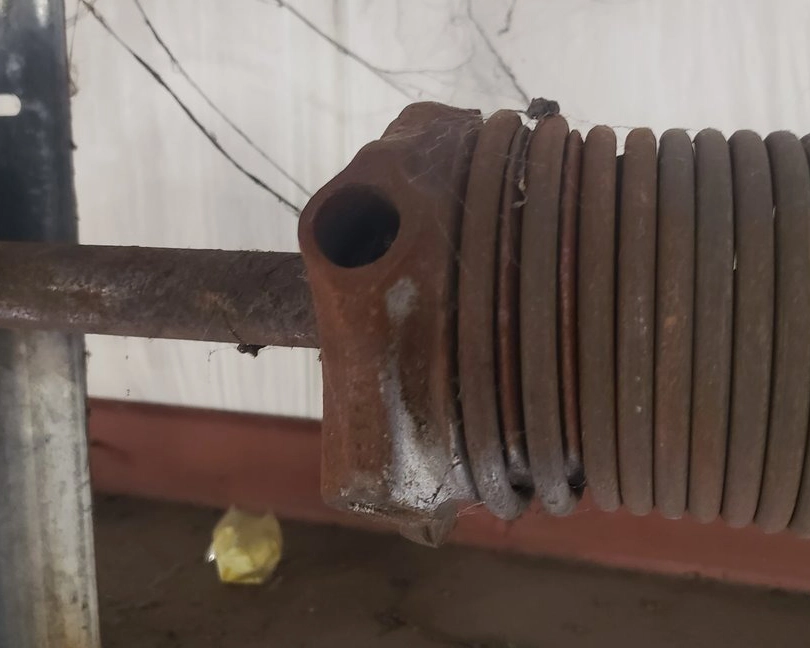
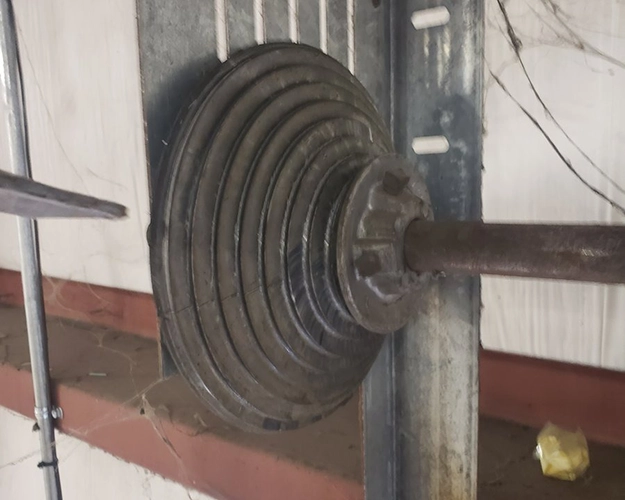
On a door that cycles all day, the spring is what wears out first, and a broken spring is how a dock door ends up staying open. IMAGE: SEASIDE GARAGE DOOR EXPERTS
Half of what I get called out for at a warehouse is not a seal problem. It is that the door will not come down, so it stays up all day and everybody stops thinking about it. Two reasons dominate.
The first is the spring. A standard torsion spring set is usually rated somewhere around 10,000 open and close cycles. A dock door running 30 cycles a day gets there in under a year of plain arithmetic. When it breaks, the door is too heavy to close safely, and the building runs open until somebody schedules the repair.
The second is a bent bottom section. Forklifts hit doors. Once the bottom panel or the bottom bar is deformed, the door lands crooked or the safety edge reads an obstruction and sends it back up. Nobody calls that a pest issue. It is one for as long as it lasts.
Worn dock bumpers feed this. When the bumpers are ground down, the trailer contacts the building instead of the block, and the first things it crushes are the seal and the door track. Bumper wear shows up as a damaged door, not as a bumper complaint.
What to put in the report
Four lines let a door contractor price the correct work instead of guessing:
1. Pit leveler: gap measured at the sides and rear, with the leveler stored. 2. Dock seal or shelter: condition of the two upper corners. 3. Overhead or rolling door: guides, bottom bar and hood, noted separately. 4. Does the door actually close, and if not, why not.
To accomplish this, do “the dock walk,” which has four stops:
1. Outside, everything closed, leveler stored. Can you see into the building? That is the pit. 2. The two upper corners of the dock seal, where the head pad meets the side pads. 3. The rolling door: both guides, the bottom bar, then look up at the hood. 4. Ask whether the door closes at the end of every shift. If the answer is “it sticks,” that is a spring or a bent bottom section, not a habit.
Why it matters
A warehouse account is a recurring account, and recurring accounts get lost over conditions nobody documented. The dock is the one place where an exclusion recommendation can be completely correct and completely useless, because the opening that got sealed was never the opening they were using.
The dock belongs to three or four trades. Reading it, though, still belongs to pest management professionals.
A result above 10 percent is a sign of strength for the month, and a reading below 10 percent is a sign of softness for the month.
“The past five months have been below the long-term average and there was no improvement in August,” William Blair Equity Researcher Tim Mulrooney said.
Dan Gordon, managing member of PCO Bookkeepers & M&A Specialists, added, “At this point, the data suggest that the industry is experiencing a sustained period of softer growth rather than a single-month fluctuation. We’ll be watching the next few months closely to see whether this is a temporary slowdown or the beginning of a longer-term shift in the industry’s growth rate.”
The month’s results by segment include:
The Residential Pest Index increased 7 percent year-over-year.
The Commercial Pest Index increased 10 percent year-over-year.
The Termite Index increased 4 percent year-over-year.
The Bed Bug Index was flat year-over-year.
The Mosquito Index decreased 3 percent year-over-year.
About William Blair/PCO Bookkeepers & M&A Specialists
The William Blair/PCO Bookkeepers & M&A Specialists Pest Index tracks the monthly performance of 159 privately held pest control companies across 40 states with combined annual 2025 revenue of $633 million. The purpose of the report is to track the monthly performance of several U.S. pest markets. It does not include residential door-to-door companies.
Insects Limited introduces Moth Block, a trademarked, pheromone-based mating disruption solution for stored products moths. Designed for use as part of an integrated pest management (IPM) program, Moth Block releases pheromone into the treatment area to disrupt male moths’ ability to locate females, helping suppress the reproductive cycle.
Moth Block gives pest management professionals and food facilities another proactive tool for managing stored product moth populations and strengthening long-term IPM programs.
About Insects Limited
Pest Management Professional (PMP) Hall of Famer David Mueller, BCE, (Class of 2019) started Insects Limited in 1981. It was founded on a statement made by one of his entomology professors, fellow PMP Hall of Famer Dr. John Osmun (Class of 1997) at Purdue University: “The future of pest control is without the use of toxic chemicals.”
Today, per its website, the Westfield, Ind.-based pheromone technology company researches, tests, develops, manufactures and distributes pheromones and trapping systems for insects in a global marketplace with a focus on the statement above. It provides products and services that are mainstream in protecting stored food, grain, museum collections, tobacco and fiber worldwide.
Demand CS insecticide with iCAP technology from Syngenta helps control more than 30 pests, including ants, cockroaches, mosquitoes and more. Microcaps containing the active ingredient lambda-cyhalothrin release over time for quick knockdown and long-lasting residual control for up to 90 days. Even when used at its low rate, it can deliver more than 10,000 microcaps per square inch of treated surface or area for greater control.
Demand CS comes in two convenient packaging options tailored for your business needs:
Demand CS 10-gallon drum (pictured)
Capable of mixing large volumes (up to 6,400 gallons of finished dilution)
No electric pump required with a simple, gravity-fed dispensing nozzle
Built-in impeller helps deliver a more consistent product uniformity
Stackable, ergonomic design for easier storage and transport
Demand CS Master Shipper
Contains 24 quarts of Demand CS in a single case
Provides up to 3,840 finished gallons of broad-spectrum, residual pest control
Purchase the Demand CS 10-gallon drum, the Demand CS Master Shipper or any combination of Syngenta products that generate at least $200 in base rebates by April 30, 2027, to automatically become a 2027 PestPartners 365 Program member — with no forms required. Plus, these purchases can get you one step closer to earning the uncapped Early Order Bonus, which can add up to 50 percent on top of your base rebate total with no limit when ordered by Nov. 18, 2026.
About Syngenta PPM
Based in Greensboro, N.C., the U.S. Syngenta Professional Pest Management division is part of Syngenta Group, a worldwide manufacturer headquartered in Switzerland. Among its many initiatives, Syngenta actively partners with conservation groups around the world to maintain natural environments and eradicate pests that threaten native species. As a developer of innovative pest control products, Syngenta works with conservationists to provide solutions to aid wildlife recovery efforts that help communities boost nature-based tourism and fuel economic growth.
In November, Syngenta marked the 25th anniversary of its founding in 2000 by the merger of Novartis Agribusiness and Zeneca Agrochemical. This milestone caps a quarter-century of innovation built on a legacy extending back more than 250 years to the founding of the Swiss chemical company Geigy in 1758. Today, Syngenta Crop Protection includes a line-up of approximately 37 seed treatments, 54 herbicides, 44 fungicides, 21 insecticides and counting.
Successful rodent control requires more than simply selecting an active ingredient. Pest management professionals (PMPs) need bait formulations that perform in real-world conditions, encourage rodent acceptance, and support effective integrated pest management (IPM) programs. That’s where SureKill brand Talon Weatherblok XT stands apart.
As part of the SureKill rodent control portfolio, Talon Weatherblok XT combines the proven efficacy of brodifacoum, a second-generation anticoagulant rodenticide, with a durable, highly palatable bait block designed for professional use. Formulated to control Norway rats, roof rats and house mice, Talon Weatherblok XT delivers single-feed control, helping PMPs quickly address rodent infestations and reduce pressure on customer accounts.
Designed to perform in demanding environments, the weather-resistant wax block maintains its integrity in outdoor and damp conditions where traditional bait formulations may be less effective. The block’s ridged design creates additional surface area for gnawing, encouraging bait consumption and supporting effective control, even in environments with competing food sources.
Talon Weatherblok XT is well-suited for commercial, industrial and other challenging accounts where durability and consistent performance are critical. When combined with proven IPM practices such as inspection, exclusion, sanitation, monitoring and strategic bait placement, it provides PMPs with a dependable tool for managing rodent populations.
As rodent activity increases during seasonal transitions and throughout the year, PMPs need solutions they can trust. By combining proven brodifacoum performance, exceptional bait acceptance, and all-weather durability, SureKill brand Talon Weatherblok XT helps PMPs deliver the reliable rodent control results their customers expect.
About Neogen
Neogenprovides a comprehensive range of solutions and services for the food processing, animal protein and agriculture industries, not only helping to protect the world’s food supply, but helping to enable its customers to produce more efficiently and effectively.
Back in 1982, per a history that appears on the Neogen website, scientific innovations blossoming out of Michigan State University needed an avenue to reach the people who could use them to better the world — solutions searching for problems. The university reached out to the men who would become Neogen’s founders, Ted Doan and James Herbert, and soon after, the company was born. What started as a small team that held organization-wide meetings in a single hallway in Lansing, Mich., expanded into new industries and new states, soon reaching across one ocean, then another. Neogen became a publicly traded company in 1989. Today, it has teams stationed in 12 countries and a sales presence in more than 140.
After both independently built successful mergers and acquisitions (M&A) firms, longtime colleagues Greg Clendenin and Graham Anthony joined forces in 2020 and created The Clendenin Anthony Partnership (TCAP).
About Graham Anthony
Worked on Wall Street at Bankers Trust (now Deutsche Bank), completing over $5 billion dollars of M&A transactions for clients.
Served as CFO of a large home services business, where he supported operations and growth and oversaw the acquisition of several dozen pest, termite and lawn care firms.
Serves as an investor in and a board member of several firms and has completed acquisitions outside of the home and facilities services industries.
Received his MBA from The Darden School and his BA from The College of Arts & Sciences, both at the University of Virginia.
About Greg Clendenin
Built Middleton Lawn & Pest Control into the 14th-largest pest control company in the country.
Led Middleton on the buy side from 2005-2007 in approximately a dozen acquisitions.
Served as COO for Sears Termite and Pest Control, which achieved annual revenues of over $100 million.
Served as CEO, COO and owner in the pest control and lawn care industries since 1982.
Served as CEO and owner of The Clendenin Consulting Group since 2018.
Served on the elected board of the National Pest Management Association (NPMA) and received the National Leadership Award in 2003.
Received his MBA with Honors from The Crummer School of Business at Rollins College.
Has successfully advised sellers in the pest control, lawn care and landscaping industries since 2018.
Their expertise
They help entrepreneurs by successfully selling their home services and business services for maximum value to buyers who do a great job with the acquisition post-sale.
Their M&A transaction expertise and entrepreneurial operating experience equal success for their clients.
Both have started, built and successfully sold multiple entrepreneurial businesses and completed more than $500 million in M&A transactions for their firm’s clients — plus closed more than $5 billion of transactions as part of earlier organizations.
Through their combined efforts, they have completed hundreds of transactions In the lawn, pest, termite, landscape, snow removal, heating, plumbing, electrical home services and commercial services industries.
What they do
Having completed hundreds of M&A transactions between independent entrepreneurs and strategic and private equity buyers, and having sold their own businesses, and having purchased businesses in the industry for themselves and others, they understand the needs of the seller as well as the mindset of acquirers. They are able to quell concerns at each stage of the acquisition process, helping you navigate that process more effectively. Visit online today or contact Clendenin at gc@clendenincg.comor 407-948-0897.
Natular DT is designed for ease of application, requiring minimal personal protective equipment (PPE). Its convenient tablet form simplifies handling and placement, making it an ideal choice for mosquito control professionals. Key advantages include:
Dual-Action Control: Provides both immediate and long-lasting protection against mosquito larvae.
Targeted Application: Specifically designed for containerized water sources, which are common breeding sites for disease-carrying mosquitoes.
Environmentally Responsible: Uses a naturally derived active ingredient, spinosad, and breaks down rapidly in the environment.
Ease of Use: Simple application and minimal PPE requirements.
Resistance Management Tool: Offers a unique mode of action for effective rotational programs.
The DT tablet’s two-layer design includes an effervescent layer that quickly releases the active ingredient spinosad, while the second layer releases slowly, providing up to 60 days of control.
About Clarke
Clarke is a third-generation, family-owned public health products and services company “striving to elevate and transform the science of vector control through the lens of sustainability and innovation.”
The Pest Management Foundation (PMF) has opened the call for applications for its 2026-2027 scholarships for a period that lasts through Nov. 30, 2026. Recipients will be announced in mid-January of 2027. Details and application instructions for all scholarships can be found online at NPMAfoundation.org/scholarships.
These opportunities include:
All-American Pest Control STEAM Trailblazer Scholarship Donor: All-American Pest Control
Wayne Golden Leadership in Action Scholarship Donors: Neighborly Pest Management, Rollins Inc., Holiday Termite & Pest Control, Payne Pest Management, Connecticut Pest Control Association, Rid-A-Bug Exterminating Co., and Latarsha Horne
About PMF
The Pest Management Foundation (PMF) serves as the charitable and educational arm of the National Pest Management Association (NPMA). It is a 501(c)(3) organization dedicated to advancing the pest control industry through urban entomology research, education and community outreach. PMF was founded in 1961 as the Buettner Pest Control Foundation in honor of William O. Buettner, NPMA’s first president and executive VP and a Pest Management Professional Hall of Famer (Class of 1998).
The VWDMA Fall Conference offers a full day of practical technical education and business management training for wildlife control operators (WCOs). Session topics include:
snake exclusion and handling
attic cleanouts
tube trapping techniques
live honey bee removal
bat management
referrals and advertising
hiring and retaining employees
building a profitable company culture
updates from the Virginia Department of Wildlife Resources
The conference has been approved by the Virginia Department of Wildlife Resources (DWR) for eight continuing education units (CEUs) toward the Virginia Commercial Nuisance Animal Permit (CNAP). While the program is especially valuable for WCOs in Virginia, WCOs from throughout the country are invited to attend and take advantage of the practical education and opportunity to connect with industry peers.
NWCOA Bat Standards Part I — Oct. 13
On Oct. 13, VWDMA will sponsor the NWCOA Bat Standards Part I course, a one-day classroom program covering bat biology and identification, inspections, exclusion techniques, safety, service agreements, pricing, decontamination, rabies, white-nose syndrome and other important aspects of professional bat management. Participants who successfully complete the course and pass the exam earn NWCOA Bat Standards Certification.
For Virginia WCOs, the course carries an additional important benefit: It has been approved by the Virginia DWR to satisfy the required additional bat-specific training and exam for CNAP holders who intend to provide bat management or exclusion services in Virginia. The course is also approved for eight Virginia CNAP CEUs.
Bat Standards Part I is also the prerequisite for NWCOA’s Certified Structural Bat Management course, which VWDMA plans to present in Spring 2027. Wildlife professionals interested in advancing their bat management credentials are encouraged to complete Part I this fall so they are prepared for the next level of training.
Both programs will take place at the Virginia Tech Richmond Center, 2810 N. Parham Road, Suite 300, Henrico, VA 23294. Registration is open to VWDMA members and nonmembers, and VWDMA extends member registration rates to NWCOA. NWCOA members should email info@nwcoa.com to request a discount code.
For program details and registration, visit VWDMA.org or contact the Virginia Wildlife Damage Management Association at office@vwdma.org or 540-376-3194.
About VWDMA
The Virginia Wildlife Damage Management Association works to advance professionalism, education and responsible wildlife management by providing training, industry resources, networking opportunities and support for wildlife control professionals.
Avoca’s AI Front Office now connects directly to Google Local Services Ads (LSA) and other major lead platforms so that you can engage new leads immediately. When a homeowner submits a request through Google LSA, Avoca responds within 30 to 60 seconds. Through your Google LSA listing, prospects can engage by text, phone or online scheduling with Avoca’s Simple Scheduler. From there, Avoca keeps the conversation moving toward a booked job. The goal is simple: Reach the prospect first, keep them engaged and turn more inbound demand into booked jobs.
About Avoca
With offices in New York City and Santa Barbara, Calif., Avoca AI was founded in 2023 by two computer science graduates of MIT. It is named after the Avoca River in County Wicklow, Ireland, where two rivers meet.
TrapNet is Bird Barrier’s newest innovation in smart, humane sparrow control, designed to help facilities respond to bird activity faster and manage trapping programs more efficiently. The system combines Bird Barrier’s Sparrow Trap Door with connected sensor technology that detects a catch and communicates with an on-site hub using reliable long-range radio. The hub then connects through its own cellular system, eliminating the need to use a facility’s Wi-Fi, while sending information to an online portal for real-time monitoring, data collection, reporting and immediate catch notifications.
Designed for warehouses, big-box retail stores, factories and other commercial facilities, TrapNet provides a non-lethal approach to sparrow management while helping maintenance teams reduce the need for routine manual trap inspections. The system supports humane capture and relocation while giving technicians greater visibility into trap activity across a facility.
The Bird Barrier team is excited to demonstrate TrapNet at PestWorld 2026 and show firsthand how connected bird control can improve response time and simplify ongoing management. Visit Bird Barrier at Booth 1113 to see TrapNet in action and learn how it can become part of a smarter bird-control program.
About Bird Barrier
Established in 1993, Bird Barrier is an eco-friendly manufacturer and supplier of bird control products and services to a global market. It specializes in urban and natural bird control to effectively relocate pest birds humanely and without harm. The Carson, Calif.-based company takes pride in providing new and modern technology that improves successful bird control and prevents unwanted birds from landing, roosting or nesting in locations that need protection.
Entomo Brands, a residential and commercial pest control provider with 23 branches across seven states, appointed Troy Lindbeck CEO to drive continued growth and expansion. Entomo Brands is a portfolio company of private equity firm CenterOak Partners LLC.
“Entomo has tripled in size since our initial investment, reflecting the strength of its platform and the significant growth opportunity in pest control services,” said CenterOak Managing Partner Jason Sutherland. “Troy’s experience scaling multi-location consumer services businesses makes him the right leader to build on Entomo’s momentum and execute its strategic priorities.”
Lindbeck has more than 15 years of senior leadership experience and a track record of scaling multi-location businesses. He previously served as president and CEO of Amenity Pool Services, a provider of pool maintenance, repair and renovation services. Lindbec also held senior roles at Pinch A Penny Pool Patio Spa, where he helped oversee operations and marketing across a network of more than 300 locations. In addition, he led marketing for more than 600 convenience stores at RaceTrac.
“Entomo has built an experienced team, an integrated platform and a strong reputation for high-quality service, establishing the company as one of the nation’s leading pest control providers,” Lindbeck said. “I look forward to building on that foundation by delivering greater value to existing customers, increasing market share in our current communities and entering new markets through acquisitions.”
About Entomo Brands
Entomo Brands is a North Charleston, S.C.-based provider of general pest, recurring termite and mosquito control services for residential and commercial customers. It operates 23 branches and serves customers across South Carolina; Virginia; Maryland; Georgia; North Carolina; New Jersey; Washington, D.C. and West Virginia. The company says its high-quality customer care and a commitment to technician training sets it apart from other pest control companies.
About CenterOak Partners LLC
CenterOak Partners LLC is a Dallas, Texas-based private equity firm managing $2.5 billion of equity capital commitments with a focus on making control-oriented investments in middle market companies. It invests in business services, industrial services and consumer services and has a history of creating significant value through organizational development, operational improvements, and transformational growth.
Since 1934, Program Brokerage Corp. (PBC) has been the go-to insurance partner for pest management professionals nationwide. As the official endorsed broker of the National Pest Management Association (NPMA), PBC brings industry-leading expertise and tailor-made coverage to keep your business safe and thriving.
Coverage at a glance
Business insurance — PBC
General liability
Property
Inland marine
Umbrella excess
Commercial auto
Workers’ compensation
Nationwide coverage (excluding Alabama, Hawaii, South Dakota and Wyoming)
Personal insurance — VIU by HUB
Home, auto, renters and other personal coverage
Compare quotes from 50+ A-rated carriers in minutes
Fully customizable, so you only pay for what you need
Manage all policies from one dashboard, even across carriers
New benefit: Personal lines through VIU by HUB
Through PBC’s partnership with NPMA, NPMA members now have access to VIU by HUB, a free online marketplace to compare personal insurance rates side by side:
It takes just a few minutes to enter your information and get comparable quotes.
Coverage is fully customizable, so you only pay for what you actually need.
Manage all your policies from one dashboard, even across multiple carriers.
Not just for you: pass it along to friends or family who want an easier way to shop.
Who’s eligible: NPMA members and their employees, friends, family, vendors, partners and business associates
About PBC
Program Brokerage Corp.is a powerful market resource known for its wide range of offerings and capabilities. The New York City-based firm is also a partner for carriers reaching out to the commercial insurance buyer in innovative, cost-effective ways, and has pioneered an innovative approach to purchasing group insurance buying, which has won popular acclaim.
One Partnership, Two Ways to Save VIU by HUB is for personal lines only. For commercial pest control business insurance, Program Brokerage Corp. remains your go-to resource.
Pest management professionals (PMPs) can now upgrade Mantis brand flying insect management systems to energy-efficient light-emitting diode (LED) technology in the way that works best for your operation:
For technicians who prefer to retrofit existing systems on their own schedule, the exclusive PestWest LED Lamp Conversion Kit (product code: 130-000328) provides a simple upgrade from 15-watt fluorescent lamps (with magnetic ballast) to LEDs. Installation requires only replacing the fluorescent lamp and starter with the included LED lamp and dedicated LED smart starter.
Now for a limited time, PestWest also offers a convenient, ready-to-use option: a complete Mantis Uplight that has already been retrofitted with LED technology (product code: 125-000553). This eliminates the need for field conversion and allows PMPs to order a fully assembled LED-equipped system — same classic design, powered by next-generation LED technology.
Why upgrade to PestWest LED Technology?
Flexible options: Retrofit an existing Mantis system or order a complete, field-ready, retrofitted Mantis LED Uplight.
Simple installation: Each conversion lamp includes a dedicated LED starter.
Each complete LED Uplight (125-000553) contains the 64-diode lamp, smart starter and the LED glue board for maximum catch.
Energy savings: Reduce energy consumption by up to 60 percent.
Extended service life: Rated for up to three years of operation.
Effective attraction: Produces 365nm UV-A light to attract flying insects.
Broad compatibility: Designed for 120-volt direct, 15-watt magnetic ballast systems.
Quality construction: Features metal end caps, an uncoated glass tube and UL-listed components.
The PestWest LED Lamp Conversion Kit (product code: 130-000328) LED-compatible black glue boards (product code: 135-000247) and complete retrofitted Mantis Uplight (product code: 125-000553) are available through preferred structural pest management distributors. Installation videos and additional LED flying insect management options are also available online.
About PestWest USA
Based in Sarasota, Fla., PestWest USA is a leading manufacturer of insect light traps (ILTs) and part of the Killgerm group of companies. PestWest offers a full range of traditional fluorescent and advanced LED ILTs, Bio-gel+ biological cleaning products, bed bug inspection tools, and expert training for pest management professionals.
Wasps and hornets are a liability that pest management professionals cannot ignore. ProVerde Wasp & Hornet Killer delivers rapid knockdown and kill in a formulation that is exempt under the U.S. Environmental Protection Agency’s (EPA’s) Federal Insecticide, Fungicide and Rodenticide Act (FIFRA) 25(b) provision.
It’s part of the AMGUARD Pest Solutions Fall Savings program, running now through Oct. 31, 2026. No enrollment form. No signing up, just order to access discounts on every case and can.
About AMGUARD Environmental Technologies
AMGUARD Environmental Technologies is an emerging provider of non-crop and specialty technology solutions for the U.S. public health; pest control; ornamental and greenhouse; golf; lawn and landscape; foodservice and consumer markets. It is the specialty markets division of AMVAC Chemical Corp., a wholly owned subsidiary of American Vanguard Corp.
From its headquarters and labs based in Morrisville, N.C., part of the Research Triangle Park region, AMGUARD discovers, develops and commercializes a diverse portfolio of proven chemistries, innovative technologies and green solutions into diverse markets. Its team is committed to protecting the population from disease vectors, mitigating structural pest damage, creating healthy foodservice environments and outdoor living spaces, and maintaining outdoor sports and recreation venues. Its mission is to provide customers with powerful technology solutions to keep their businesses strong and growing.