In order to identify the U.S. cities most vulnerable to pest infestations, Excel Pest Services assessed multiple factors that influence both pest activity and the likelihood that infestations will occur and persist once established.
Each city was evaluated across six core indicators:
Population density: In densely populated cities, pests are able to spread more quickly between properties due to shared walls, plumbing systems, waste infrastructure and closer living conditions.
Population-weighted search interest for “pest infestation”: This measures how often people search for pest infestation-related terms relative to city size, which allows fair comparison between larger and smaller cities.
Search trends over the past 12 months: These trends indicate whether concern about pest infestations is increasing or decreasing in each location over time.
Average annual precipitation: Higher rainfall creates moist environments that pests such as insects and rodents rely on for consistent water availability.
Average maximum temperature: Warmer climates allow pests to remain active for longer periods, which increases reproduction rates and reduces seasonal population decline.
Median year homes were built: Older housing stock is more likely to contain ageing materials and structural gaps, which makes it easier for pests to enter and establish themselves.
Who’s most likely to experience infestations?
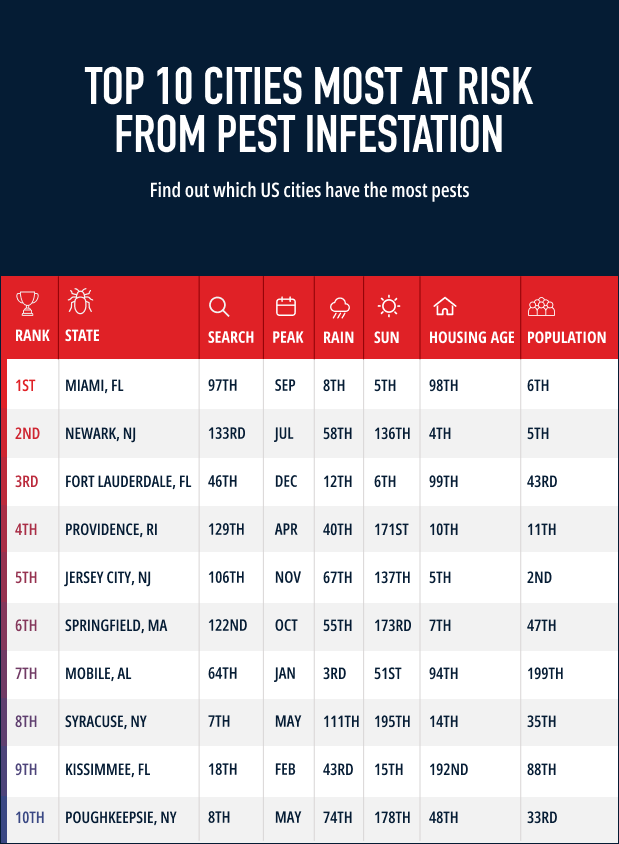
- Miami, Fla.
- Known for its warm temperatures and high humidity throughout much of the year. With long, hot summers and frequent rainfall, conditions rarely slow pest activity, allowing insects and rodents to remain active well beyond the typical summer season. Miami ranks fifth nationally for average maximum temperature and eighth for annual precipitation, creating consistently warm and damp conditions that support year-round pest survival and reproduction. It also ranks 6th for population density, increasing the likelihood that infestations can spread between neighboring properties via shared infrastructure.
- Newark, N.J.
- Newark’s position is shaped primarily by structural factors rather than climate. The city ranks fourth nationally for housing age and fifth for population density, indicating that ageing buildings and shared infrastructure significantly increase the likelihood of pest entry and spread.
- Fort Lauderdale, Fla.
- Fort Lauderdale ranks third overall, reinforcing the role of climate-driven pest risk in coastal Florida cities. The city ranks sixth for average maximum temperature and twelfth for annual precipitation, producing warm, moisture-rich conditions that support pest survival and reproduction throughout much of the year.
- Providence, R.I.
- Providence’s position in the top five illustrates how structural factors can elevate pest risk even in cooler climates. The city ranks tenth for housing age and eleventh for population density, reflecting closely packed and ageing buildings that are more vulnerable to pest entry and internal spread.
- Jersey City, N.J.
- Jersey City presents one of the clearest examples of density-driven pest risk. Ranking seconnd nationally for population density and fifth for housing age, the city’s tightly packed and older housing infrastructure creates ideal conditions for infestations to spread between properties. Even without extreme heat or rainfall, pests can move efficiently through shared walls, plumbing systems and waste infrastructure.
About Excel Pest Services
Excel Pest Group strives to use an integrated pest management (IPM) approach to best fit the needs of its customers and the environments in which they live. Excel is partnered with Johns Hopkins Lyme Research Center, providing them with key field knowledge and outcome data to improve Lyme Disease outcomes.
<p>The post The most vulnerable US cities to pest infestations first appeared on Pest Management Professional.</p>
from Pest Management Professional https://www.mypmp.net/the-most-vulnerable-us-cities-to-pest-infestations/
Sacramento CA

No comments:
Post a Comment