Mealworms are the larvae of yellow mealworm beetles (Tenebrio molitor), a darkling beetle species. They are generally categorized as stored product pests. However, a PMP must always be prepared for the unconventional. Here are two situations where I encountered these insects far outside their expected habitat.
Key takeaways
- Look to the exterior: For an inexplicable indoor pest problem, you must always go to the exterior to inspect for invading perimeter pests.
- The power of questioning: Never stop asking questions until you start getting answers that make sense and reveal an unconventional root cause, such as infested fill dirt.
- Be prepared for behavior: Do not jump to the conclusion that a pest problem is what you came to treat; it just might be a behavioral “people problem.”
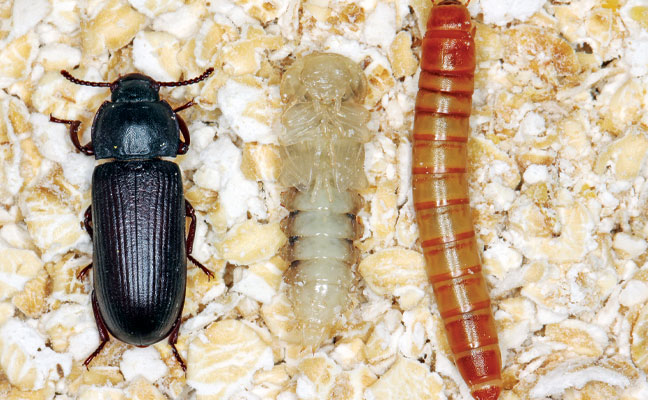
IMAGE: GettyImages / Tomasz Klejdysz
Case study 1: Perimeter invasion from infested soil
After finishing a training session with a local pest management firm on Long Island, N.Y., I was informed by a supervisor about a residential account having a persistent problem with mealworms crawling in the basement, first and second floors and attic. The lady of the house was ready to sell just to get away from the mealworms.
The investigation and root cause
The house was newly built in a new development of private homes and no other homes in the area had this issue. An exterior inspection revealed hundreds of mealworms crawling around the back perimeter and up the exterior wall. Poking around in the soil, I found hundreds more very active mealworms.
After asking a few more questions, the answer became clear: to level the land at this specific site, the builder had hauled in truckloads of soil. Wherever the soil was taken from, it was heavily infested with mealworms.
The two-month solution
Our multi-faceted control strategy focused on elimination and prevention:
- Chemical control: We applied a perimeter residual around the structure and as far out as the label allowed.
- Exterior trapping: We placed polyvinyl chloride (PVC) pipes—4 feet long, 3 inches in diameter and open on both ends—along the back and sides adjacent to the house. We then placed long paper glue boards inside each PVC pipe.
- Exclusion: We pest-proofed all the exterior doors and windows leading into the basement.
- Interior cleanout: Indoors, the initial mealworms were vacuumed and we placed glue boards in each room.
For the next two weeks, the glue boards kept catching mealworms and were replaced as needed. It took about two months until no more mealworms appeared inside the structure.
Case study 2: When the pest problem is people
I was called in because mealworms were appearing in a child’s bedding and his mother was very upset.
The immediate concern was to find the source. However, the solution in this case was not biological, but behavioral: The child was seeking attention. He would buy live mealworms from a pet shop, dump them on his bed and then call his mother for help. In his closet, we found the containers of the mealworms he had purchased.
In summary
These two cases highlight three essential lessons for every PMP:
- Always go to the exterior to inspect for invading perimeter pests, even if the problem is reported indoors.
- Ask questions until you start getting answers that make sense and reveal the true source.
- Do not jump to conclusions. Be prepared for unusual circumstances or the possibility that the “pest problem” is actually a “people problem.” And last but not least, never turn down an interesting job even if you are tired at the end of the day—the unique cases teach the most.
<p>The post <i>PMP</i> case study: Mealworm cases that weren’t stored product pests first appeared on Pest Management Professional.</p>
from Pest Management Professional https://www.mypmp.net/pmp-case-study-mealworm-cases-that-werent-stored-product-pests/
Sacramento CA

No comments:
Post a Comment