Dr. Jose Pietri, the O. Wayne Rollins/Orkin Endowed Chair in Urban Entomology at Purdue University, is leading new research that challenges established beliefs about how German cockroaches transmit disease.
With funding from the National Institutes of Health (NIH), Dr. Pietri’s lab is examining the biological mechanisms of Salmonella transmission, uncovering findings that suggest these pests are more than just passive carriers.
Key takeaways
- Active replication: Salmonella bacteria are not just carried on the cockroach’s exterior; they replicate within the gut and establish long-lived populations.
- Transmission vectors: German cockroaches typically transmit the bacteria through feces in kitchens and food preparation zones.
- Resistance risk: There is a potential for Salmonella to acquire antimicrobial resistance (AMR) from other bacteria within the cockroach gut, complicating treatment for humans.
Beyond passive transmission
Traditionally, the scientific consensus held that cockroaches acted as mechanical vectors — picking up a specific amount of Salmonella from a contaminated source and dispersing it at random as they moved through an environment.
However, Dr. Pietri’s findings indicate a more complex biological relationship. The lab has discovered that the bacteria actually replicate within the cockroach gut, establishing a long-lived population. The current phase of research focuses on determining the implications of this replication for human disease.
The threat of antimicrobial resistance
The study highlights a significant public health concern regarding antimicrobial resistance (AMR). German cockroaches, which typically transmit Salmonella through their feces in kitchen and food prep areas, host a variety of bacteria in their guts. Some of these naturally occurring bacteria possess AMR traits.
Dr. Pietri noted in a news release that because bacteria can exchange genetic material when sharing an environment, Salmonella could potentially acquire these AMR traits inside the cockroach.
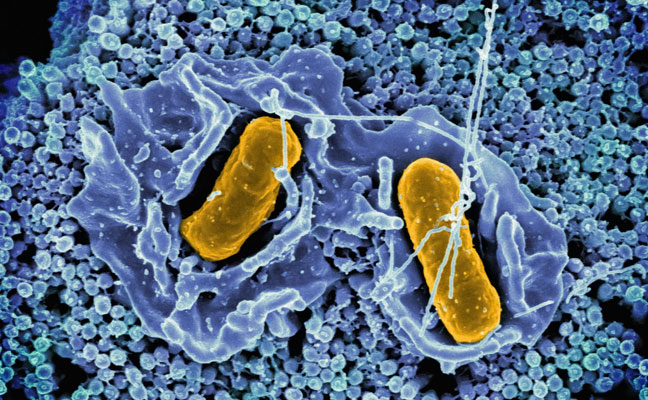
If this genetic exchange occurs, the AMR could be passed to humans who contract Salmonella from cockroach-infested areas. This would make the resulting infection significantly more difficult to treat, presenting an elevated threat to public health.
More online
To read the full study details from Purdue University, visit: ag.purdue.edu/news/2025/07/studying-howsalmonella-hitches-a-rideon-cockroaches.html
<p>The post Purdue University: <i>Salmonella</i> is replicating in German cockroaches first appeared on Pest Management Professional.</p>
from Pest Management Professional https://www.mypmp.net/purdue-university-salmonella-is-replicating-in-german-cockroaches/
Sacramento CA

No comments:
Post a Comment