Scorpions are old. In fact, they are likely the first animals to venture onto land some 437 million years ago, probably living as semi-terrestrial arthropods. At that time, the world would have been quite harsh, with both temperature and carbon dioxide levels significantly higher than today. Ancient seas were extensive, teaming with early life and encouraging organisms to transition onto land.
Conditions have moderated since those distant days, but scorpions haven’t changed much since that early time. They certainly have adapted to becoming the second fully terrestrial animal (after millipedes), but their aquatic forebears passed on traits that have helped them survive in a changing and less stable environment than that of the ocean from whence they came.
One big change was converting their exterior book gills through which they breathed in the water to the interior book lungs for breathing on land. This change allowed them to adapt from semi-aquatic to fully terrestrial animals.
Since then, the scorpion has changed very little. Why would they? The scorpion body plan, though primitive, is perfect for survival — especially in dry environments like those of the primitive earth. Many species live in some of the most arid places on Earth today, such as the deathstalker scorpion (Leiurus quinquestriatus), but this doesn’t preclude other species from living in a variety of other environments like forests. Let’s look at a few representative species in each region of the U.S.
East Coast: The predominant species is the southern devil scorpion (Vaejovis carolinianus). This small species is considered harmless and occupies mostly forested areas.
![Southern devil scorpion (Vaejovis carolinianus) [Image: epantha / iStock / Getty Images Plus / Getty Images]](https://www.mypmp.net/wp-content/uploads/2026/08/GettyImages-647110172.jpg)
Central Region: The genus Centruroides, or bark scorpions, includes common species with often potent venom. The striped bark scorpion (C. vittatus) predominates in this region. It spends most of its time on the ground and often enters homes and other human structures. Stings are common, but rarely dangerous.
Southeast: In Florida and the coastal plains of Georgia and Alabama, the hentzi striped scorpion (C. hentzi) is common. Its sting is mild. The Florida bark scorpion (C. gracilis) is an introduced species common in the Sunshine State. It originates from Central and northern South America, Mexico and the Caribbean.
Southwest: The Arizona bark scorpion (C. sculpturatus) frequently enters homes. It is the only U.S. species considered dangerously venomous, with human deaths reported. This species, in true bark scorpion fashion, prefers trees but will live under a variety of landscape items such as river rock. Human activity in transforming desert areas into lush green landscapes has allowed this species to thrive.
![Arizona bark scorpion (Centruroides sculpturatus) [Image: BOB GILBERT, BCE, PHE, Blue Sky Pest Control]](https://www.mypmp.net/wp-content/uploads/2026/08/C.sculpturatus-TM.jpg)
In the Sonoran Desert region specifically, two commonly encountered species are the Arizona giant desert hairy scorpion (Hadrurus arizonensis) and the stripe-tailed scorpion (Paravaejovis spinigerus). The desert hairy scorpion is a long-lived burrowing species; the stripe-tail can be found under rocks and other debris, where it seeks out areas of moisture. Neither scorpion is considered dangerous. In fact, the desert hairy scorpion is considered beneficial, as it will eat bark scorpions.
Pacific Coast: The California common scorpion (Paruroctonus silvestrii), a burrowing species, occupies arid areas along the coast, while the western forest scorpion (Uroctonus mordax) lives in wooded areas. Both species have a mild venom and are not considered dangerous.
In addition to the adaptation to book lungs from exterior gills, scorpions have other features that can help them survive today and consequently make them hard to control as pests. To combat these morphological and behavioral defenses, let’s look at each of these in turn and relate their biology to a control strategy that works.
The belly of the beast
If you turn over a scorpion and look at its ventrum, or underside, you will see four pairs of small openings along the mesosoma, or abdomen. These spiracles, or slits, are the openings into the book lungs and how a scorpion breathes.
![Fig. 1. Four pairs of spiracles (yellow spots) run the length of the mesosoma below the paired pectines on this Arizona bark scorpion. [Image: BOB GILBERT, BCE, PHE, Blue Sky Pest Control]](https://www.mypmp.net/wp-content/uploads/2026/08/PMP0826_Figure1R.jpg)
![Fig. 2. Close-up of spiracle opening, or slit, visible below the pecten.[Image: BOB GILBERT, BCE, PHE, Blue Sky Pest Control]](https://www.mypmp.net/wp-content/uploads/2026/08/PMP0826_Figure2R-512x1024.jpg)
Unlike insects, scorpions transport oxygen via their blood-like hemolymph. Because the spiracles are on the bottom of the scorpion, it can be difficult to avoid certain chemical treatments such as dust (see Fig. 1). Appropriately labeled dusts, applied where scorpions hide during the day, can enter these lungs, get absorbed into the hemolymph, and travel throughout the scorpion’s body.
Also on the ventrum, scorpions have paired appendages used for tactile and chemical perception, which they evolved to track prey, find mates and avoid predators. These pectines, along with sensory organs on the legs, allow them to detect and avoid chemical treatments (see Fig. 2).
This has been shown in the Arizona bark scorpion. This species detects repellent chemicals and will raise its entire body off the treated surface to avoid them. This behavior is termed “stilting” and, when crossing a flat treated surface, can minimize exposure and avoid a lethal dose. However, the treatment of transition sites where the scorpion moves from a horizontal to a vertical surface or vice versa increases the likelihood of touching the treated surface and gaining a fatal dose. The treatment of these transition locations, such as ground to building foundation to J-trim, becomes critical for climbing scorpion species.
Exoskeleton defenses
Scorpions have a thick exoskeleton, coated with a thin, water-repelling wax layer that helps prevent them from desiccation (see Figs. 3 and 4). These cuticulin/wax layers also protect scorpions from physical harm. Products that can penetrate these layers can kill scorpions, including appropriately labeled, non-water-soluble products such as pyrethroids. Products that remove or cut through the wax layer also may kill the scorpion through desiccation. Products such as diatomaceous earth or silica gels, which attack this layer, also can be effective when applied correctly. These products are particularly effective when used in arid or low-humidity environments.
![Fig. 3. Transverse cross-section through the arthrodial membrane (between segments) of the cephalothorax of the Arizona bark scorpion, showing a dorsal view of the hardened exterior layer of the exoskeleton (top) above the dark body cavity. The scale at the bottom shows 1-millimeter-wide blue bars.[Image: BOB GILBERT, BCE, PHE, Blue Sky Pest Control]](https://www.mypmp.net/wp-content/uploads/2026/08/PMP0826_Figure3R.jpg)
![Fig. 4. Anterior (face) view of an Arizona bark scorpion, showing the thick exoskeleton.[Image: BOB GILBERT, BCE, PHE, Blue Sky Pest Control]](https://www.mypmp.net/wp-content/uploads/2026/08/PMP0826_Figure4R.jpg)
Scorpions are strongly nocturnal, spending nights primarily hunting for prey or searching for mates. They can detect light through their entire exoskeleton and move away from light instinctively (see Fig. 5). During the day, these animals find shelter in harborages for protection. Some species reuse an established burrow for years, while others find a new shelter each day.
![Fig. 5. An Arizona bark scorpion takes a defensive pose under ultraviolet light, showing light reactivity. [Image: BOB GILBERT, BCE, PHE, Blue Sky Pest Control]](https://www.mypmp.net/wp-content/uploads/2026/08/PMP0826_Figure5R-1.jpg)
For burrowing species, the burrow can be treated directly. This would include species such as the giant desert hairy scorpion — a long-lived ambush predator with the potential of living more than 20 years.
Other scorpions seek tight cracks and crevices for harborage, as they are strongly thigmotactic, which essentially means they feel safe when pressed into tight places. They often seek shelter under rocks, bark or debris, so treating underneath such harborage areas is critical in scorpion control.
Granular and liquids
The Arizona bark scorpion has no permanent home but finds a new hiding spot before each dawn. For species like this, the use of appropriately labeled granular residual pesticides can be very effective in harborages like river rock and bushes. Watering in these products activates them, which the scorpions find difficult to avoid in this type of cover. Bark scorpions also hide in palms, trees and under bark, so granular or liquid treatments around tree trunks can be effective.
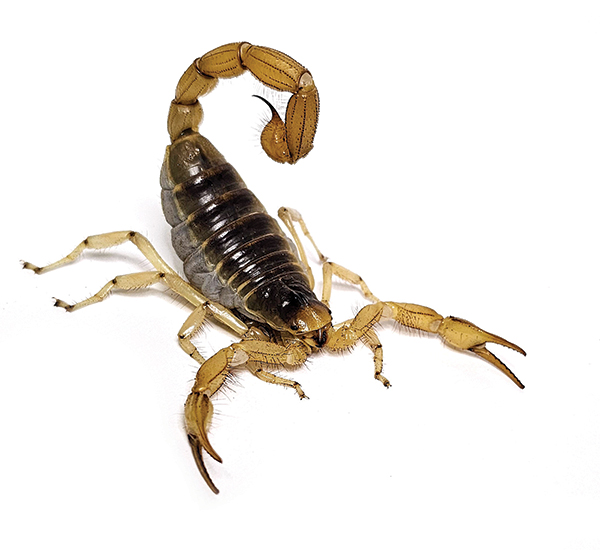
Photos: BOB GILBERT, BCE, PHE, Blue Sky Pest Control}
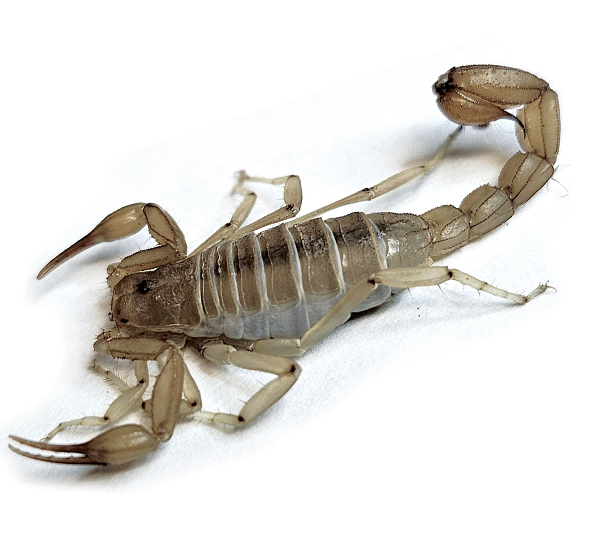
Stripe-tailed scorpion (Paravaejovis spinigerus) [Photos: BOB GILBERT, BCE, PHE, Blue Sky Pest Control]
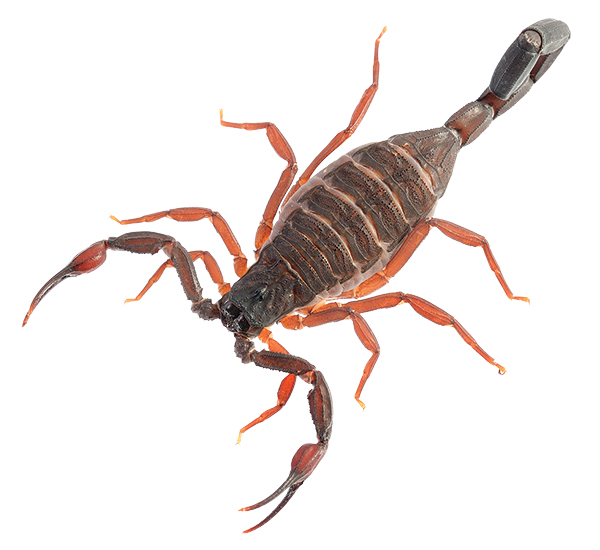
iStock / Getty Images Plus / Getty Images]
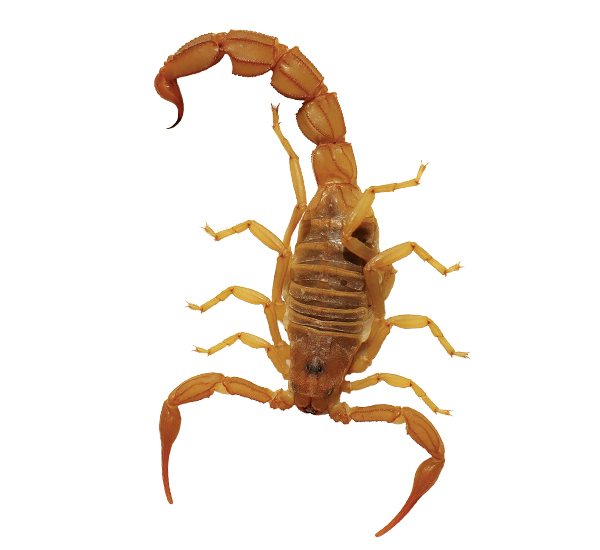
iStock / Getty Images Plus / Getty Images]
Scorpion prevention efforts
Like all pests, if food is scarce, scorpions will relocate. Insect control will help keep their numbers to a minimum.
Scorpions also hate to be exposed to daylight, so removing hiding places like trash, debris and river rock on the property can go a long way in minimizing scorpion numbers and keep them out
of structures.
Move flowerpots up onto stands rather than keeping them directly on the ground. Thin out bushes, keep grass mowed, and remove leaf piles or other items under which scorpions can hide.
Inspect the structure and replace any worn or damaged weather stripping or window screens. Install door sweeps and screen rooftop vents. Trim trees away from the structure to avoid bridging onto the roof.
Scorpion anatomy explains scorpion behavior. It shows us how they hunt, hide, breathe, climb and avoid danger.
These adaptations have kept scorpions alive for hundreds of millions of years, but they also reveal the control points we need to target. Understand the animal, and the treatment becomes more precise, more deliberate and more effective.
References
1. Polis, G.A. 1990. The Biology of Scorpions. Stanford University Press, Stanford, Calif.
2. Romero, A., J. Agnew, E. Paysen and B. Blakely. (2021, October). “Arizona Bark Scorpions and Their Responses to Insecticides.” Pest Control Technology, 49(10), 40-44.
3. Gaffin, D.D., Bumm, L.A., Taylor, M.S., Popokina, N.V. and Del Castillo, S. (2012). “Scorpion fluorescence and reaction to light.” Animal Behaviour, 83(2), 429-436.
<p>The post Pest Trends: Ancient adaptations still shape modern scorpion control first appeared on Pest Management Professional.</p>
from Pest Management Professional https://www.mypmp.net/pest-trends-ancient-adaptations-still-shape-modern-scorpion-control/
Sacramento CA

No comments:
Post a Comment