Pest management has become a darling for private equity (PE) and strategic buyers because it offers what they want: recurring revenue from large numbers of profitable customers of a similar type in the buyer’s targeted geography that stick around for years. By understanding and packaging each of seven specific aspects in detail, pest management professionals (PMPs) can guide their businesses to maximize value in a sale.
1. Focus

Buyers tend to seek “pure-play” assets, which are firms that are largely focused on either a commercial or residential customer base and that provide predominantly one type of service. Bear in mind, however, that a buyer’s focus often changes over time as they grow and seek more firms to acquire, leading them to add services or customer bases they might not have considered a year earlier.
The key to a higher sale price is to know who is buying what and when, and to put your well-tailored offering in front of them at just the right time.
2. Size
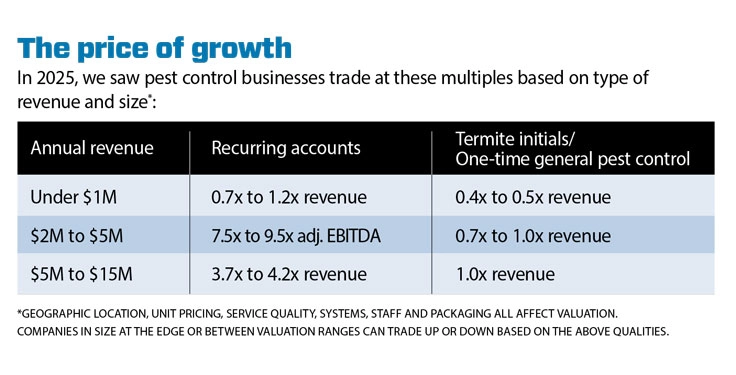
Bigger businesses are valued more highly simply because the buyer can acquire more revenue in one go. Currently, businesses face valuation inflection points at different sizes:
 Businesses under $1 million in revenue are more challenging to sell and tend to trade at lower multiples. Unless a buyer is set up to do small, tuck-in acquisitions, it is just too much work for too little revenue for most buyers to buy this size business.
Businesses between $2 million and $5 million in revenue see their valuation driven by how close a match their base is to the buyer’s desired customer mix (see No. 1), how much profit each job delivers (see No. 5), and profit per truck route (see No. 6).

Businesses between $5 million and $15 million in revenue trade on similar value drivers as above but garner strong multiples, as they can either be highly accretive add-ons to a business in a given market or a foothold in a new market for the buyer.
Businesses with more than $15 million in revenue are rare and can act as a platform for a buyer looking to enter the industry. Value is driven also by the quality of the management team, systems and reputation in their markets.
3. Recurring revenue
Simply put, buyers place a much lower multiple (if any) on one-time work. Preferences for types of recurring revenue change over time. In the late 1990s and early 2000s, for example, termite renewals were valued far more highly than general pest control (GPC). Today, they can be valued above or below GPC based on retention rates.
4. Revenue retention
Firms with high retention rates and low customer churn are viewed as better-managed and worth more money than those with significant churn. Even a few percentage points of churn make a material difference in valuation.
5. Gross margin
This margin is derived from customer revenue minus the hard costs of providing the service. A smaller firm’s customers being tucked into existing routes are, to a large extent, valued on the gross margin that those customer accounts provide the new owners once layered onto their existing routes.
6. Route economics
Consider the amount of revenue per truck, less the cost of the technician, materials, gasoline and other vehicle expenses. How much contribution margin, or profit toward overhead, does a given route provide?
Different buyers track different metrics, but in general, clearly presented, profitable route economics will drive the price. The higher the contribution margin from the route is, the more highly the buyers will value the business. For larger businesses, this also holds true for the profitability of each branch office.
7. EBITDA
Adjusted EBITDA is the base number on which most buyers apply an acquisition multiple to value a business. Actually, that amount is EBITDA plus the owner’s personal expenses that are not necessarily business-related, as well as non-recurring business expenses, such as remodeling the office or installing a new air-conditioning system.
In truth, most buyers are looking at free cash flow once they own the business. Depending on the size, smaller firms are more likely to be valued on route economics, or even gross margin on the service itself if the acquired customers are likely to be aggregated onto the buyer’s existing routes. They then add in route density and increase the profitability of each route.
The bottom line: Packaging the business correctly and presenting it to the right universe of buyers in the right way will maximize value.
FACT: A multiple is a financial shortcut used to quickly estimate a company’s valuation. It compares the total value of a business to a specific financial metric, such as earnings or revenue. By multiplying this figure by a chosen metric, buyers and sellers can arrive at a purchase price.
Anthony and Clendenin are principals of the Clendenin Anthony Partnership. Visit Clendenin-Anthony.com for more information.
<p>The post 7 factors that drive the value of a pest management business first appeared on Pest Management Professional.</p>
from Pest Management Professional https://www.mypmp.net/7-factors-that-drive-the-value-of-a-pest-management-business/
Sacramento CA

No comments:
Post a Comment